







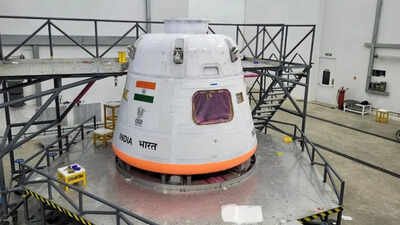
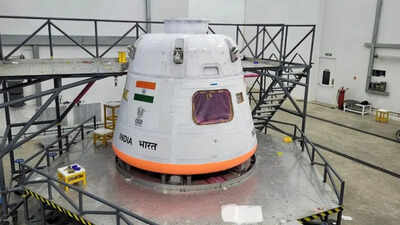
BENGALURU: After back-to-back launch failures of PSLV and a quiet few months, the Indian Space Research Organisation (Isro) may have tasted success in a critical test conducted as part of preparations for Gaganyaan.While the space agency is yet to make an official statement about the second Integrated Air Drop Test (IADT-02), union minister Jitendra Singh, made the announcement through a congratulatory message. “Congratulations Isro for the successful accomplishment of Second Integrated Air Drop Test (IADT-02) for Gaganyaan, India’s first human Space flight scheduled next year. The second Integrated Air Drop Test (IADT-02) was successfully conducted at Satish Dhawan Space Station Sriharikota. This marks an important milestone towards the readiness for the Gaganyaan mission,” Singh posted on Friday.The IADT-02, a follow-up test of the IADT-01 conducted nearly eight months ago on Aug 24, 2025, was expected to be conducted much earlier. But as with most aspects relating to the Gaganyaan mission, Isro has faced delays.Isro chairman V Narayanan had refrained from giving a concrete reply on IADT, or Gaganyaan on April 8. He had only said that the space agency was working on it.While the exact parametres of the test have not been made public by Isro at the time of writing this and calls were unanswered, the IADT-02 was expected to involve a simulated crew module with a mass of around 5 tonne, maintaining the external configuration similar to flight, and dropped from an altitude to validate the parachute system.In the actual mission, these parachutes will eventually bring back astronauts safely under the Gaganyaan mission. As per Isro’s initial plans, seven IADTs had to be conducted. However, multiple sources have confirmed to TOI that the number may change and the space agency could conduct fewer tests.During IADT-01, the simulated crew module was dropped from an altitude of 3.1km using an Indian Air Force (IAF) Chinook helicopter. The test was a joint effort of Isro, IAF, DRDO, Indian Navy and Indian Coast Guard.In line with the plan, the drop took place over the Bay of Bengal and lasted about an hour from take-off to recovery, though the final parachute deployment sequence was completed in just 2-3 minutes.While Singh, in his post has announced that the Gaganyaan mission would happen next year, the timeline is not expected to be met by Isro, which has been struggling with delays. There are several key technologies that need to be validated before India can send humans to space.