








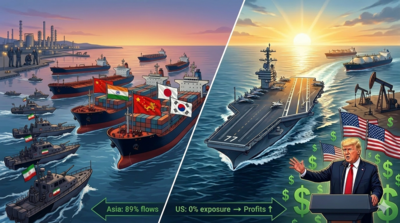
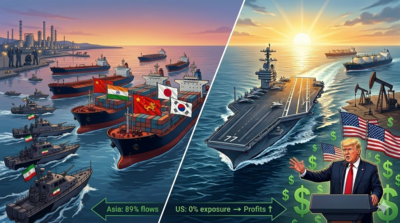
President Donald Trump’s recent appeal to Asian allies to help secure the Strait of Hormuz amid escalating tensions in the war against Iran, bluntly brought to focus their outsized reliance: “Countries that receive oil through the Strait of Hormuz must take care of that passage — China, Japan, South Korea should come and aid us.“Days later, after most allies rebuffed his plea for joint naval patrols, Trump decisively flipped the script: “The US needs no one’s help.” This pivot left room for interpretation on military action but firmly signaled America’s relative indifference to the strait choke — bolstered no doubt by its energy independence and minimal exposure.
Total indifference
Nowhere is the indifference most stark than in the statements of White House officials. Treasury secretary Scott Bessent said the Navy would escort tankers “as soon as militarily possible”. Energy secretary Chris Wright told CNBC the military is “not prepared” right now, prioritising strikes on Iran’s missile and nuclear sites over escorts, calling disruptions “short-term” (weeks, not months). The US Navy informed the shipping industry that escorts are “not possible now,” with no commercial vessels escorted to date despite early retracted claims.
Asia’s underbelly exposed
The about-face revealed a brutal truth: While Asia gasps from throttled crude, LPG, LNG, and distillates (jet fuel & diesel), America not only dodges pain but cashes in on higher prices and export booms.
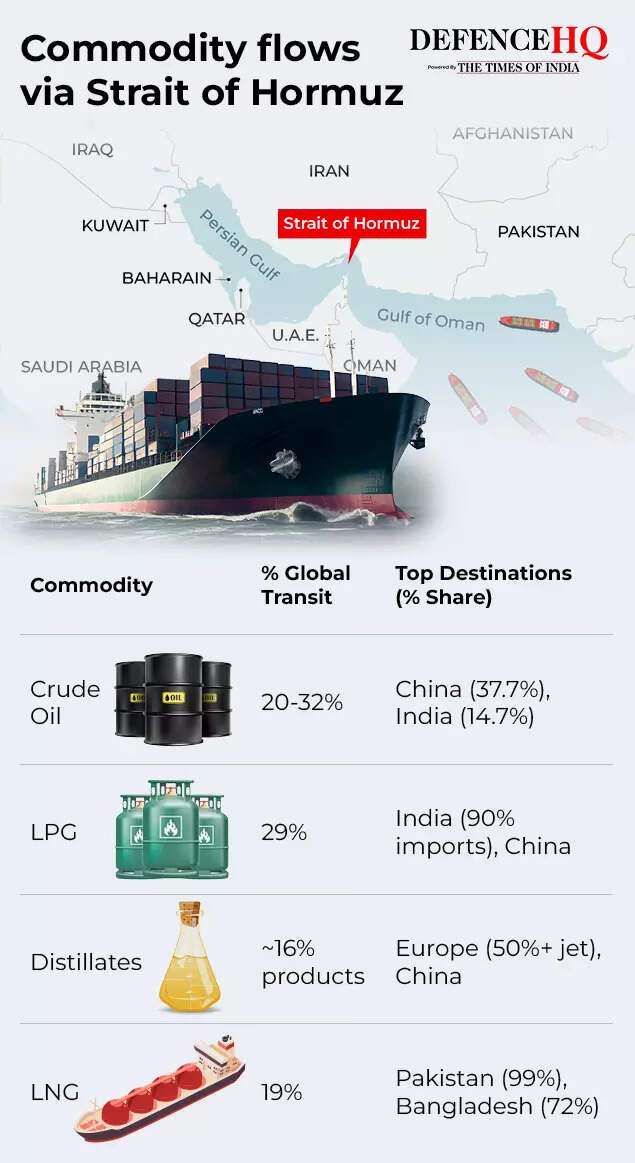
The strait choke — handling 20-32% of global oil, 29% LPG, 19% LNG — exposes vulnerabilities everywhere but the US comes out with a slick shine.Nestled between Iran and Oman, the 34-kilometre-wide strait funnels vital energy to Asia, which slurps 89% of all flows. China devours 37.7% of crude, India 14.7%, South Korea 12%, Japan 10.9%, with Indonesia and Vietnam splitting the rest. LPG hits harder: India routes 90% of imports — 60% of national needs — from Qatar and UAE. Pakistan (~85%), China (~80%), Japan/South Korea (70-80%) reel similarly.Distillates, including diesel and jet fuel, deliver additional pain.
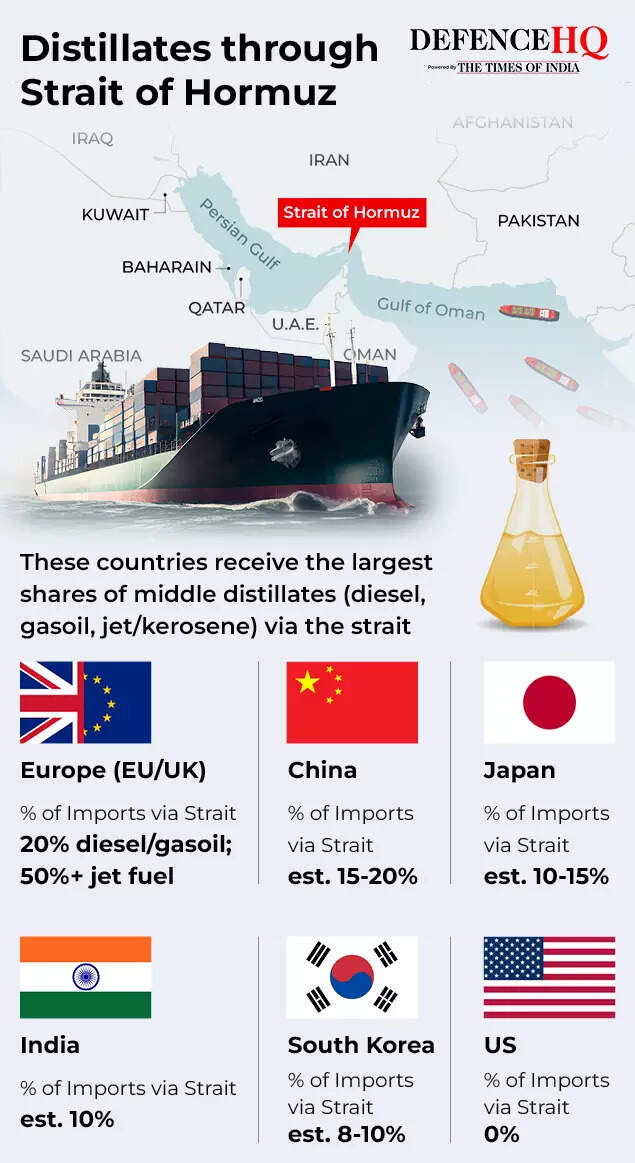
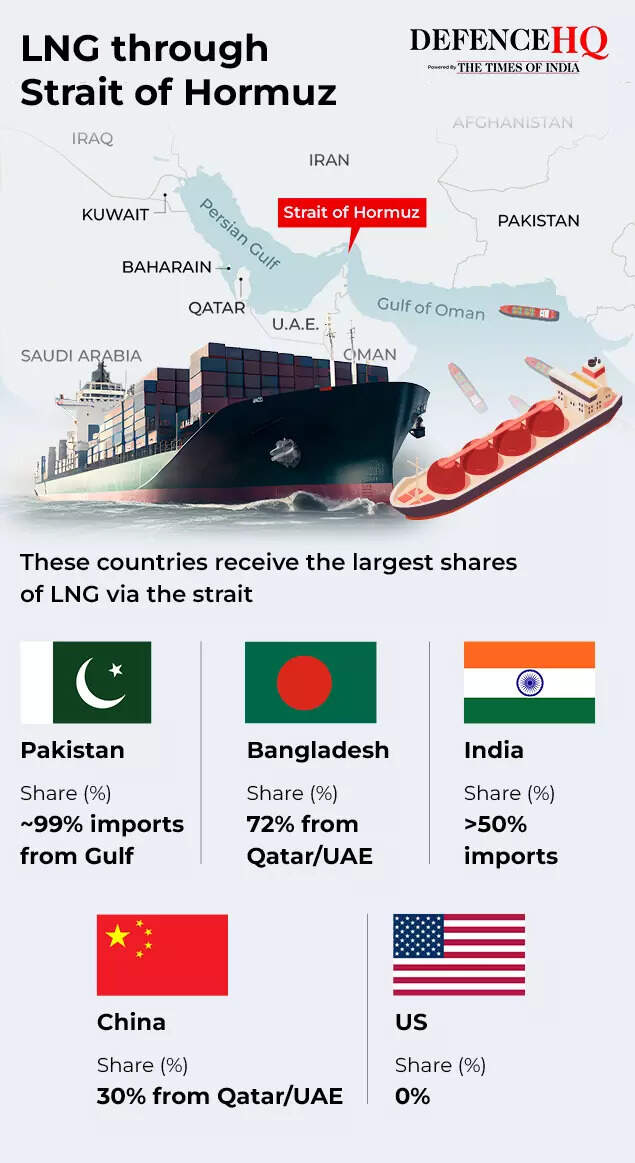
Europe relies on the strait for over 50% of its jet fuel imports and about 20% of its diesel and gasoil, totaling more than 50 million tonnes of diesel and 25 million tonnes of jet fuel annually. In Asia, China takes an estimated 15-20% share, while Japan, India, and South Korea each import between 8-15%.LNG flows (Qatar-dominated) batter South Asia: Pakistan ~99%, Bangladesh 72%, India >50%, China/Japan trailing. Fertilisers, which make up one-third of global seaborne trade, and naphtha, with 37% heading to East Asian petrochemical plants, exacerbate risks to agriculture and industry.
The partial blockade imposed by Iran has intensified these problems. Only about 90 ships have managed to pass through recently, mostly carrying Iran’s own crude oil destined for China. Oil prices have surged beyond $100 per barrel as a result, forcing refineries to idle operations.
India feels the squeeze
India provides a clear example of the strait’s stranglehold. Before the disruptions intensified in early 2026, India relied on the strait for 14.7% of all flows transiting the chokepoint, with crude oil imports from this route valued at $61.4 billion between August 2025 and February 2026 alone.
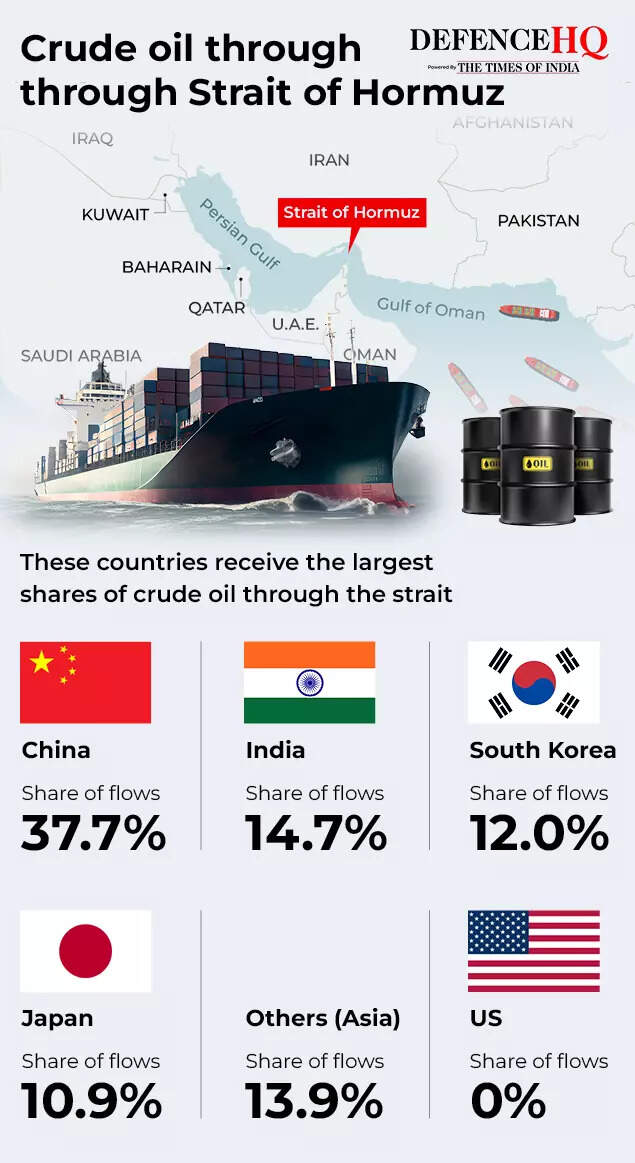
This volume — millions of barrels daily from Saudi Arabia, Iraq, and the UAE — powered refineries and fueled economic growth, but disruptions forced a rapid pivot, with India securing 70% of its crude from non-Hormuz sources like the United States and Russia by mid-March.The LPG situation proves even more acute and personal, striking at the heart of everyday life for over 300 million households dependent on subsidised cylinders for cooking. India imports roughly 20 million metric tonnes of LPG annually to meet demand, with domestic production covering only 40-45% of needs, leaving the remainder critically exposed to Gulf suppliers.
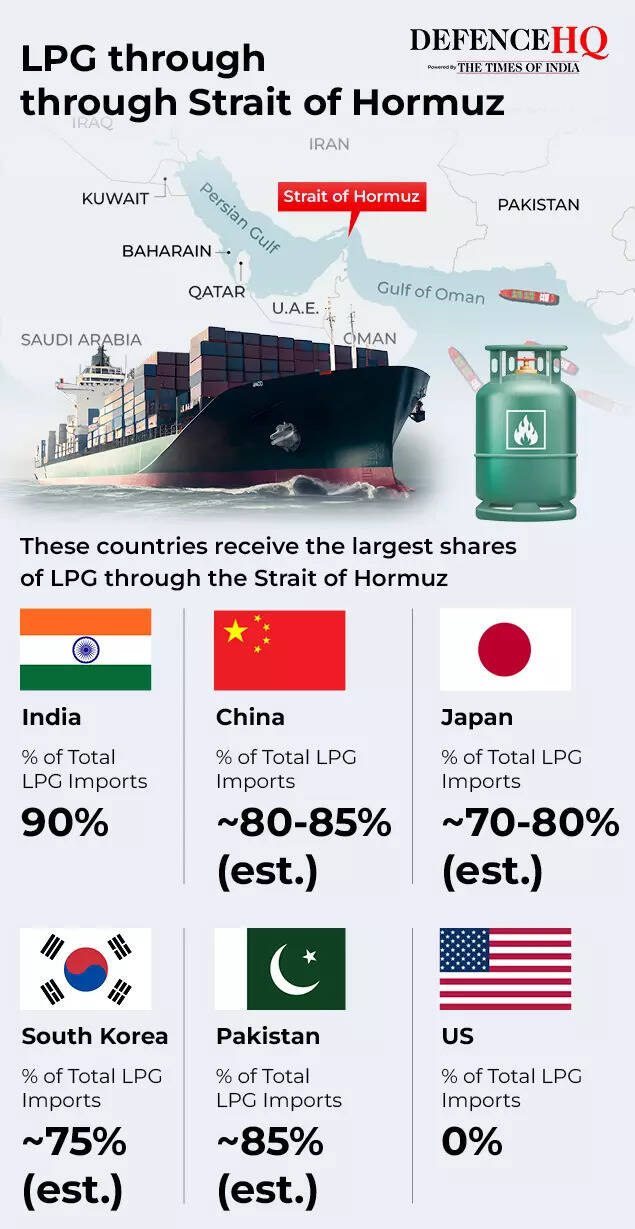
Qatar dominates as the top exporter, providing 34% of these imports — equivalent to 5.33 million metric tonnes valued at $4.04 billion yearly — followed closely by the UAE at 26%. Saudi Arabia and Kuwait fill the next slots, forming a Gulf-heavy portfolio that transits almost exclusively through the strait.With 90% of India’s imported LPG — about 60% of total consumption — flowing via Hormuz, the partial blockade triggered government huddle. India ramped up domestic refinery output by 25% and inked emergency deals with Norway and the US for alternative cargoes, including a landmark 2.2 million tonnes per annum US agreement. Iran granted special passage to three Indian-flagged tankers in March — carrying vital LPG from Qatar —offering temporary relief, but the underlying vulnerability persists.
Gulf & Asia suffer; US rolls in profits
Gulf producers including Saudi Arabia, the UAE, Qatar, Kuwait, and Iran suffer substantial revenue losses from the effective shutdown of 21 million barrels per day of oil capacity.Qatar’s LPG and LNG deliveries to Pakistan and India have virtually stopped, while refined products — 16% of global trade — disrupt supplies across Europe and Asia.Even food imports for Gulf states now require costly rerouting.In stark contrast, the United States reaps direct profits from this chaos. As the world’s top oil producer at 13 million barrels per day and leading LNG exporter, America has maintained net energy surplus status since 2019. Its exposure to the strait remains minimal to zero: crude oil imports are less than 0.5 million barrels per day mostly from non-strait Gulf routes, with Canada covering 70% via pipelines. LPG and LNG imports stand at 0%, and distillates at 0-0.5%.The disruptions fuel American gains. Higher oil prices boost shale profitability, while exports to Asian markets skyrocket as they seek diversification — India signed a 2.2 million tonne LPG deal just months before the war started, and Europe ramps up US LNG purchases. US refiners process cheap domestic crude into high-value products for global sale. Trump’s March 17 declaration—”We don’t need their help”—captures this opportunistic reality.While Japan and South Korea build stockpiles and China turns to Russia, the US seamlessly captures lost market share.Global trade faces upheaval, with UNCTAD estimating $1 trillion in annual energy commerce at risk. Rerouting cargoes around Africa adds weeks and massive costs, raising stagflation fears for importers. Europe hunts for diesel and jet fuel alternatives, and Asian refineries contemplate 20-30% output cuts.The crisis accelerates long-term changes. India has shifted 70% of its crude to non-Hormuz sources and boosted LPG production, while China pursues Venezuelan supplies (virtually US controlled) and Japan expands reserves. However, pipelines cannot replace maritime routes overnight, requiring years for full adjustment.
Geopolitical realignment
Hormuz unmasks Asia’s soft underbelly. Iran’s ability to threaten closure sends shockwaves from New Delhi to Tokyo. Trump’s progression from demanding allies “step up” to embracing US profits marks a new era of American primacy, where self-reliance generates wealth. With reelection on the horizon, exports outweigh military entanglements. Asia suffocates under the weight — China’s voracious 37.7% crude appetite, India’s critical 90% LPG dependency, Pakistan’s near-total LNG cutoff — while the United States fills its coffers.